 I represent the print media and am a devoted citizen of my country. Therefore I can confidently state that I am a Citizen Journalist. Today as a Citizen Journalist I do not need to hold a Journalism degree but what is absolutely indispensible to my position is a camera, a recorder and of course being in the right place at the right time.
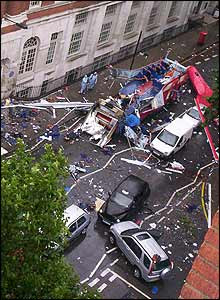 Click image for reader pictures on BBC
7/7/2005. Central London was struck by suicide bombers and the underground railway system was ripped, killing around 52 people and injuring many more. Life came to a standstill with that event and then began a series of investigations and accusations. However all footage of the event, at least the one shown by news channels would be from several moments after the horrific event. Until of course they knew a bomber was about to strike! However in this rat race of 'breaking news' and who cover the entire story first with EXCLUSIVE footage is where citizen journalism gains prime importance. At this point of time news channels opened up all channels to acquire any material from onlookers to support their coverage. BBC news watchers who witnessed the entire event grabbed this opportunity and photographed the entire debacle and realizing the dire need of the hour immediately sent it across to the BBC news team. The photographs were uploaded on the site the very next day. The audience should know the capacity of the destruction that occurred but as a citizen does one have the right to capitalize on others misfortunes?
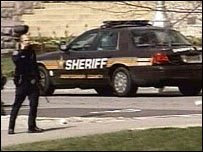 Click image for eyewitness forum on BBC
While millions watched on TV the aftermath of a mentally troubled student's open fire on the campus of Virginia Tech University, there were many who witnessed the nightmare and lived to recount it on various news portals. All online news sites and blogs opened their lines to discussion and eyewitness counts to enhance the interactivity with the audience and gain an in-depth analysis of the matter. There is no doubt that the stronger voice of the audience is having a beneficial effect on the range of stories and perspectives that journalists cover. But do such discussion forums lead to unearthing more dirt than being beneficial?

This year's biggest news ever in the UAE was supported by a reader's picture that was pasted on the front page of all leading newspapers. The massive pile-up on the dreadful Tuesday of March 11th, dubbed as the biggest car accident in the UAE was caught on tape and photographed on camera phones by those in the vicinity. Perhaps all the facts and figures that newspaper articles depicted were from personal recounts and photographs. The 8 column photograph that ran in all newspapers, with the cars on fire was sent by a reader who happened to take a shot that explicitly explained the magnitude of the catastrophe. Because media cannot be everywhere, newspapers need to rely on citizens for additional scoop on events. This news was fodder for video enthusiasts who made it to the scene to shoot the destruction and upload it on YouTube. Personally I wouldn’t view such a video and replay horrific images, which need to be forgotten rather than make gruesome hair rising content. With such freedom bestowed upon a civilian who derives satisfaction only from the fact that someone is viewing 'his work', boasting about the number of hits his content received; are we shrugging off the responsibilities that the traditional school of journalism has at its core?
Gulf News Citizen Journalism Policy
The 11 Layers of Citizen Journalism


Rewiew of The Kite Runner by The New York Times

Those watching the book unravel on the big screen; first have to familiarize themselves with raw actors, seen rarely on film. Once that is out of the way, readers try to find the intricacy that keeps them hooked to the book. Many gripping moments may not gel with the visualization of the reader. Another drawback moviegoer's face is the constant attention division between the subtitles and the onscreen motion, missing out on unique moments. Breathtaking locales are a saving grace to the entire bookish adaptation debacle. However, giving credit to the captain of the ship, the direction is worthy of praise. Marc Forster brought out the best of the child protagonists and adult Amir (Khalid Abdalla) was topnotch as a spineless man.
Read the movie review at: MovieFreak
 Aishwarya Shivkumar walking the ramp at Fashionova2008
Photo: Afshan Ahmed
Meet Aishwarya Shivkumar; a 3rd year Media Student who until now could be seen only walking the corridors of MAHE but after this big break may be seen walking at renowned Fashion Shows as well. Pursuing a specialization in Visual Communication, Aishwarya is a lady of many talents. A complete go-getter she can sing, dance, paint, play the piano and is up for any challenge that comes her way. Modeling being a personal interest since childhood she graced many ads and corporate calendars as a child. A favorite on the local scene and college competitions, Fashionova 2008, a Fashion Show with some of the biggest models walking the ramp, happened by chance and just the night before.
We spoke to Aishwarya about her opportunity of a lifetime:
Aishwarya: Two of the designers wanted to showcase an extra garment in their collection at Fashionova. Since all the models were flown down from India they needed someone to step in at the 11th hour. Thus I was approached and was more than willing to oblige.
A:You got to model with some of the biggest names in the Fashion Industry! Tell us about the experience?
AS: It was phenomenal! This is the first time I have modeled on such a huge platform. I haven’t got any formal training and being professionally trained by Marc Robinson was just wonderful.
A:How was it like backstage with such seasoned models?
AS:Well, everyone kept to themselves and since I was new to the backstage chaos I did feel a little out of place. Having said that, the volunteers did their best to make me comfortable and guided me through the backstage drill.
AS:I haven’t decided yet. I'm still trying out other things as well. However if opportunities such as these knock on my door I won't decline.
Best of luck girl!
 Marc Robinson ~ Photo: Joseph John
Marc Robinson: It began around 3-4 years ago. I’ve been doing a lot of work in India as a Fashion Show Director and at that time I got a mail from MAHE Manipal and being prompt with my mails I replied back immediately. Surprised at the quick response she stated that she had done research on my work with the faculty and other designers and that is how my association began with her and the other faculty.
A: How has your association been so far?
MR: It’s been always pleasant coming back to Dubai, coming back to MAHE. I’ve seen it evolve and it’s grown. The students have progressed immensely and there are state of the art techniques that have happened. The styles and designs, ideology and thinking has improved
A: From modeling to choreography…how did that jump happen?
MR: It’s inevitable! I mean when you are interested in fashion and you like the glam business and you know what you are doing and if you have a keen eye to understand how the garment has to be displayed and you have management skills and are interested in sound, lighting and have the marketing skills, put it all together. It’s not only choreography… you are called the show director now.
A: What do think about the creations from our designers this year?
MR: I think they are very very good this year
A: Do you think there is a potential in the fashion industry to absorb so many upcoming fashion designers
MR: Definitely! It happens all over the world and it happens very successfully and its inevitable in Dubai as well.
A: So you think the scope is pretty good?
MR: Yea! That’s why we have so many Fashion Weeks happening in Dubai because there is a huge potential over here.
A: A few words of advice to our aspiring designers…
MR: Be innovative! Market yourself in the best possible way and try to get experience by working with established fashion designers and then branch out on your own and maintain your own style and your own sense of individuality. Definitely! It happens all over the world and it happens very successfully and its inevitable in Dubai as well.
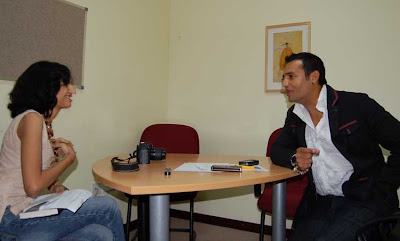
Its all about Fashion ~ Photo: Joseph John

Shakuntala Devi: I’m fine, thank you very much
SD: Wonderful! You see I’m a world traveler so I’m always happy to be in new countries, meeting new people and every time I’m geared up for doing work and spreading the perfume of mathematics all over the world.
A: How do you take your numbers to be, are they personalities, is that how you remember them?
SD: Numbers have a life according to me. They are not just symbols on paper. They are beautiful numbers.
A: Is this something that is inborn or does it have to be learnt over a period of time?
SD: Well, in my case, I was born with numbers. Now I am also trying to pass it on to people. I would like to spread it around.
A: So..it can be learnt?
SD: Learnt means…it depends on what extent. It actually takes an interest and love for it is very important.
A: Is there any regime you need to follow?
SD: No, I don’t follow any regime. I’m one of those people who don’t have a regime.
A: Apart from numbers, you are also into astrology and I’ve heard you’ve written cook books as well. So where has the love for so many varied fields come about from?
SD: (Surprised) How did you know?
I’ve written cookbooks because I like to eat and if I want to eat I need to cook. In foreign countries I never find food to my liking. However, the writing of the book has a story behind it. I have visited Universities in America and England and the group of Indian students would invite me to join them in their apartment after the show. They would cook for me…Indian delicacies. I would intervene at that time and ask them to avoid complicating the dishes while assisting them. They would later ask me for recipes but due to lack of time I would send it to them via mail.
It later struck me why don’t I make it a book?! So I contacted my publisher and we came up with –Cookery For Men (laughs)
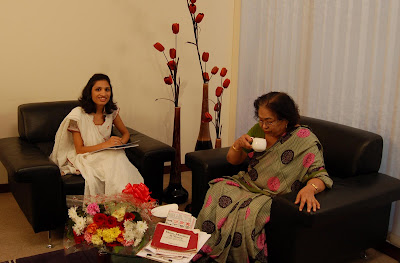 Conversation over a cup of coffee. Photos: Christina Marshall
A: Is there anyone interesting you have come across in your travel of the world?
SD: Well, every single human being is interesting. So it’s hard to say. Everybody is very special. It’s amazing how God has made everyone special and different.
A: In this age where everyone is so dependant of computer for all their activities…
SD: Yes, really unfortunate…
A: Do you think they will replace or replicate our mental abilities?
SD: Sad, you must believe in yourself. I am one of those who preach; believe in yourself… At least I believe in myself and that makes me capable of doing anything at any time. Do not be completely dependant on your computer. For example e-dairy, you store phone numbers in it. If one day you were to loose it…what happens?
A: Oh! Am in a total mess and in a complete quandary.
A: So how much technology do you apply in your life?
SD: Not much, I am one of those people who shun technology. I’m very basic. I keep my feet on the floor and do not want to fly in the air.
A: Finally ma’am, you’ve successfully made many children overcome their fear for number…
SD: Yes 100%
A: What advice would you give this generation to motivate them towards a subject that is considered at times dull and difficult?
SD: I run workshops in which I pledge to the parents that within 8 hours I will turn their child 180 degrees In favor of mathematics. Even the dullest children have overcome their fears and are now getting A grades. I have also written a book about a girl who was incompetent in mathematics and how she gradually emerges as a great mathematician. I’m very fond of doing this!
You should see how depressed children feel when they are not good in mathematics. Somehow the world looks up to people who are good in mathematics. Take me for example, I think I am a person of average intelligence but people think I’m extraordinarily intelligent because I do mathematics. If I was poor in it and good at all the other subjects they would consider me dull.
Right from the initial stages children begin to form a complex of not being good in mathematics. It should be tackled at that level.
Quite recently there have been lot of suicides in India, students commit suicides you know because In fact I read in the papers that one boy dropped dead because he didn’t get the sum right and the teacher started taunting him. So I just feel that I should do it with a missionary’s zeal to remove this stigma of the fear of mathematics.
So the next time you extend your hand towards a calculator, give your grey cells a chance first!

Style from the Past
A Photographic Society like any other club or society brings together like minded individuals who share a common passion: to capture the worlds delights on film. The first society could probably be spotted on the map of
Cropping the distance
Melanie Jones, whose husband insisted she buy a camera, is an avid member of the Light chasers, a photographic society operating at the Cultural Foundation of Abu Dhabi. All her fears were banished at the first meeting she attended. “I was never into photography. My husband forced me to one of their sessions at which he was already an active member. Though initially it felt like alien terms were being hurled at me, the colloquial attitude eventually put me at ease.” Asking her about the need for such clubs she was quick to point out the inherent nature of man to display his talent to the rest of the world. The societies give individuals a chance to share their work and gain insights of the rest of the members. Redha Qallabi, a member of the Qatar Photographic Society shares a similar view. However, while Melanie is an amateur, Redha is a working photographer. This clearly depicts the concoction of people that form a part of these societies. “We learn from one other,” said Redha, “This is how we develop ourselves as photographers.”
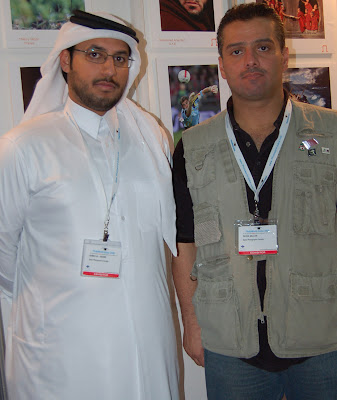 Redha Qallabi (Right) Photograph: Afshan Ahmed
Enhancing the vision
With the advent of online communication, it is said that the world is at our finger tips. With online forums and an ocean of avenues to render ones work why do we need tangible societies and clubs? “These clubs provide the benefit of a teacher-pupil relationship. The World Wide Web may provide you with all your answers but it lacks the aspect of personal one-on-one communication,” said Melanie. A formed society develops norms and guidelines for itself, the parameters within which the photographers display their effort. Maitri Somaia, a media student, appreciates the fact that she can capture locals of
Join the Club
Members meet weekly, bi-weekly or monthly to discuss various aspects of photography. Clubs may charge a membership fee or can be absolutely free. While many of these societies are group endeavors, some successful clubs are recognized by the government. “Our society is sponsored by the Government of Qatar. We are constantly encouraged to set higher bechmarks in the field of photograph and very soon we are planning to begin diploma courses as well,” said Redha Mohammed. Maitri, on the other hand stumbled upon a club on Google that doesn’t charge anything for sharing her passion. “I joined the Photographers Club through a social community website which I landed on while browsing for photography information.”
Photographic societies in the
Some of the Photographic Societies that have an open membership in the

