Showing posts with label Views. Show all posts

Scene I: Bhajji walks out of the dressing room, make-up and all. This will be his best shot. This is his big moment. He walks to the center of the field.

Director: Andddd Action -Phaaat! One Tight slap! The melodramatic hero reduced to tears while all relatives run to the victim to provide their shoulder in this time of distress.

A scene from a Hindi movie…..or a scene from the recent IPL. The line is a blur!


The Indian Premier League, a recent creation by the BCCI, is another big money making machine for all those involved. The game that follows the twenty20 format has more moolah going around than any other professional sports today. It began with crickets being auctioned as commodities. The highest bidder got to own an entire cricket team that would rake in million for the next few years. Of course the front runners in the game were the big-wigs of the country including some of the top names from Bollywood. Teams comprising of the best players from around the world battle it out for prize money that would secure the future of their next two generations.

A game once attached to prestige and loyalty for one's country has now diminished into any other business where pride and honor have gone out the window, or rather off the field. All teams are backed by Bollywood stars, which mean all brands they endorse automatically get linked. Also such star power attracts media hype and all actions, on and off the field is scrutinized. From its initiation in April the DLF has made more Indian news than any other national news in the country. And why not…when it brings in the TRP's who would want to eliminate such content for the sake of true journalism? Leading Indian News channels have dedicated 50% of their time on the DLF. NDTV 24x7 has molded some of its program formats to that of this Twenty20 game. Every single move of the cricketers as well as team associates is captured and analyzed. And by moves, not those with regard to the game per se but quite the contrary. In the last two months the number of controversies generated on the cricket field in India speaks for the dire situation the game has come to.

Like any other typical Bollywood movie, more masala and more action generate more revenue. Similarly, on the field more drama creates media hype. Right from unacceptable uniforms of the cheerleaders down to enmity among players everything has been BREAKING NEWS. Honestly, the attire of a foreign cheerleader on the field is irrelevant to a cricket lover. And when other mediums don’t shy from flaunting a woman's body, why the upheaval now?

The media has got its priorities wrong. While calamities hit many parts of the world this year, news channels continued to give more air time to a game considered a religion in India. In this ironic situation, the game has lost its honor and prestige among true cricket lovers while at the same time has made those who don’t know the stumps from the wicket watch the game for sheer star power.
Tune in for more filmi spices onto the cricket field.


Its all about T20

I represent the print media and am a devoted citizen of my country. Therefore I can confidently state that I am a Citizen Journalist. Today as a Citizen Journalist I do not need to hold a Journalism degree but what is absolutely indispensible to my position is a camera, a recorder and of course being in the right place at the right time.

Today, the argument about what makes the news has transcended to a level of WHO makes the news. A struggling reporter for whom, earlier it would be a near impossible feat to get a byline and would have to slog hours to reach a respectable position can now conveniently publish all material sans an organization. All media forums and new media are embracing what are called 'citizen journalists' with open arms, harnessing the advantages of the burgeoning citizen journalism phenomenon. The Internet with its infinite space and storage provides platforms like blogs, YouTube, networking sites to upload almost anything and everything. Most often than not, used and misused, but nevertheless this is one of the most popular way to be heard!

Citizen Journalism also called participatory journalism, as the dictionary states, gives citizens the responsibility of collecting, reporting, analyzing and disseminating news and information. While views and reviews on stories always formed a part of news content across various traditional media outlets in the past, now they are being professionally incorporated into news items and also form leads to new stories. Hard core news sites like CNN have introduced their own initiative of Citizen Journalism with ireport, a network that allows anyone to upload and discuss news focused content. Editor's gatekeep all content and around 10% of all submissions get published. But is this journalism? What about all the ethical baggage that comes along with a profession?

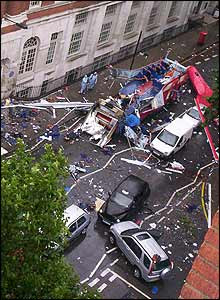
Click image for reader pictures on BBC

I was there
7/7/2005. Central London was struck by suicide bombers and the underground railway system was ripped, killing around 52 people and injuring many more. Life came to a standstill with that event and then began a series of investigations and accusations. However all footage of the event, at least the one shown by news channels would be from several moments after the horrific event. Until of course they knew a bomber was about to strike! However in this rat race of 'breaking news' and who cover the entire story first with EXCLUSIVE footage is where citizen journalism gains prime importance. At this point of time news channels opened up all channels to acquire any material from onlookers to support their coverage. BBC news watchers who witnessed the entire event grabbed this opportunity and photographed the entire debacle and realizing the dire need of the hour immediately sent it across to the BBC news team. The photographs were uploaded on the site the very next day. The audience should know the capacity of the destruction that occurred but as a citizen does one have the right to capitalize on others misfortunes?


Click image for eyewitness forum on BBC


I was a part of it
While millions watched on TV the aftermath of a mentally troubled student's open fire on the campus of Virginia Tech University, there were many who witnessed the nightmare and lived to recount it on various news portals. All online news sites and blogs opened their lines to discussion and eyewitness counts to enhance the interactivity with the audience and gain an in-depth analysis of the matter. There is no doubt that the stronger voice of the audience is having a beneficial effect on the range of stories and perspectives that journalists cover. But do such discussion forums lead to unearthing more dirt than being beneficial?


Closer to home
This year's biggest news ever in the UAE was supported by a reader's picture that was pasted on the front page of all leading newspapers. The massive pile-up on the dreadful Tuesday of March 11th, dubbed as the biggest car accident in the UAE was caught on tape and photographed on camera phones by those in the vicinity. Perhaps all the facts and figures that newspaper articles depicted were from personal recounts and photographs. The 8 column photograph that ran in all newspapers, with the cars on fire was sent by a reader who happened to take a shot that explicitly explained the magnitude of the catastrophe. Because media cannot be everywhere, newspapers need to rely on citizens for additional scoop on events. This news was fodder for video enthusiasts who made it to the scene to shoot the destruction and upload it on YouTube. Personally I wouldn’t view such a video and replay horrific images, which need to be forgotten rather than make gruesome hair rising content. With such freedom bestowed upon a civilian who derives satisfaction only from the fact that someone is viewing 'his work', boasting about the number of hits his content received; are we shrugging off the responsibilities that the traditional school of journalism has at its core?


Each of those stories would not have been possible, certainly with the speed with which they were produced, without the new technologies that allow intense interaction between journalist and audience. But it is in the area of the contested news agenda and opinions about the news agenda in which public participation raises the most interesting dilemma. The average citizen can now make news, act that was once only the province of seasoned journalists. At the same time the rigors and ethics involved in the act of reporting are being ignored in this new wave of journalism. Privacy is now a thing of the past and people's emotions are being played with. You cannot expect a civilian to understand, that grief while reporting a sensitive issue has to be minimal for, the aim is to inform not create a furor. Perhaps user generated content is the need of the hour, but at the same time media education to such individuals, who contribute such content, is imperative. However calling it journalism is a farfetched ideology. If all citizens could report, it would defeat the very foundation of a profession. As long as new media survives, user content will help reinvent and develop powerful content for online news, information and entertainment. But journalist….he is not!


Gulf News Citizen Journalism Policy


The 11 Layers of Citizen Journalism


Watching through the minds eye

Reading provides news dimensions to ones imagination. It opens up ones senses making everything subjective to the reader. Many a times, popular novels and biographies are adapted onscreen. But do they translate and connect with an audience who has already created their own visual movie through their minds eye? The problem is that while some books make successful movies, many crash at the box office due to lack of substance.


The Kite Runner - Worth the Read

A book venture by first time writer Khaled Hosseini, "The Kite Runner" was an instant bestseller when it hit book stands. In the present scenario where war ravages in almost all parts of the world, the writer has packed the life of a boy seeking acceptability and superiority with the backdrop of a turbulent country environment. Connecting readers with forgotten emotions the book is a nail bitter till the very end.
This heart wrenching winner will raise every hair of your body making you question human traits of honesty loyalty and devotion. Set in the backdrop of the atrocities that contaminated the Afghan Society during the Taliban rule and the Soviet invasion this book tells a story about Amir whose innocence is tainted by ulterior selfish motives and grows up to repent all the pain he inflicted.

Rewiew of The Kite Runner by The New York Times
Did the same tension the book promised from its first page which it successfully delivered till the very end translate onscreen?
Apparently Marc Forster, the director didn’t do much to keep the kite flying high! Known for intense drama and award winners such as Monsters Ball and Finding Neverland, The Kite Runner is a disappointment, both for movie buffs and book worms. While adapting the gist of the story aptly, the director could not capture the internal turmoil of the individuals that made the book such a sensation.


The Kite Runner - Not Worth the Watch
The film follows the story of two boys living a contended life in Afghanistan around the 1970's. While one is the son of the respected businessman, the other a son of a servant. This status difference doesn’t stop Amir (Zekiria Ebrahimi) and Hassan (Ahmad Khan Mahmoodzadaand) from bonding and spending their entire childhood exuding innocence and flying kites. Life goes on, with Hassan sacrificing all for the other and Amir, in his yearn to gain the respect of his father, baring his inner demons. Testing times approach with Hassan being raped by a gang of boys (all in the tender age of adolescence) and Amir fails his companion by turning away. With the invasion of the Soviet in 1979, Amir and father are dispelled from their roots and follow a path that takes them to a land of dreams, America where their endeavor to build their life again. Expecting to leave behind all the guilt baggage, Hassan's loyalty and Amir's cowardice comes back to haunt him.
Those watching the book unravel on the big screen; first have to familiarize themselves with raw actors, seen rarely on film. Once that is out of the way, readers try to find the intricacy that keeps them hooked to the book. Many gripping moments may not gel with the visualization of the reader. Another drawback moviegoer's face is the constant attention division between the subtitles and the onscreen motion, missing out on unique moments. Breathtaking locales are a saving grace to the entire bookish adaptation debacle. However, giving credit to the captain of the ship, the direction is worthy of praise. Marc Forster brought out the best of the child protagonists and adult Amir (Khalid Abdalla) was topnotch as a spineless man.

Read the movie review at: MovieFreak


Risky Waters- Should Directors Adapt?
Adaptation genre is a tricky territory. It is near impossible to build the aura of a bestselling book. Imagination being individual specific, readers probably approach adaptations with a preconceived vision, which once not created leads to immense discontent. The filmmaker has to bind a 326 page book into a 2 hour film and therefore has to forgo instances that a reader may look forward to. Comparison apart, someone who is oblivious of the raging book, approaching the film as another of Mark's masterpiece will leave the theater with renewed understanding of world that is ravaged by violence and mayhem.

Confession

Forgive me Lord, for I have sinned!
It was just a truculent circumstance.
I was in my own moment.
It was just a horrid mistake.
I digressed from my path.

I never meant to hurt anyone, I had my own flight to take. I was driving along a lonely path waiting for dawn to break.
I never meant to bring sorrow, but now my soul has left me and my sins have caught up.
Forgive me Lord, for I have sinned
I never meant to kill her,
the myna whose imperceptible blood spells callous on my windscreen.

Escapism is a requirement for keeping an individual’s sanity intact. The traditional forms of release are the television, radio, reading or an outing. The new transporter on the block is the virtual world courtesy the Internet.

The virtual world is a computer stimulated world aping the real world but allowing you to play God and giving you a chance to create a ‘NEW’ ‘IMPROVED’ you, called an avatar. These virtual worlds have now become a massive online business providing multi-player online role-playing games such as EverQuest, Guild Wars and the popular Second Life.

Despite some of the tedious prerequisites of these worlds like download speed, time spent on creating the avatars, a graphics card and the availability of cash to update the new you, it has managed to attract masses of gaming enthusiasts and Internet addicts. Taking advantage of this obsession many multinational companies including Nike, Sony Entertainment, Toyota and Apparel have teamed up with this booming business and provide their specialized lines to these gaming sites at a charge they consider minimal, for hours of pleasure. These virtual worlds are the next frontier in blurring advertising and entertainment.

The virtual society is like a playground where an individual can fulfill all his fantasies. Unlike his real life, here he can be in absolute control and this very factor drives the demand for these virtual worlds. Man today, despite being the master of all, has developed a sense of insecurity in him. The reassurance that he is a significant part of the world draws him into a fake world.

One major weakness of people tends to come to the forefront, the fear of isolation and the need to prove themselves. The constant need for companionship is fodder for the virtual world. It provides a platform for not only meeting people from all over the world but also challenging them and displaying ones skills.

Though they are an extension of the gaming industry these virtual world platforms are now being adopted for commerce, education, military and vocational training.

It isn’t long before the thick line between ‘real’ and ‘fantasy’ becomes a distant blur.

What do I do for the world to recognize my existence? Simple! Make a ridiculous video and upload it on YouTube. A sure shot formula for visibility.

YouTube was the brain wave of two young men Steve Chan and Chad Hurley who never ventured into Web 2.0 with the idea of making it big. However they went on to be so popular that even Google could not resist buying this company at a price of $1.65 billion. The two freshmen have not been able to settle down with all the popularity yet, and YouTube has already scaled new heights of popularity.

YouTube works on the keywords ‘easy’ and ‘cheap’. Resigning from the technicalities and budget system of television or any other media outlet it allows people to display their video making talent. What more… you do not even need a studio to make a video. It is a potpourri of individual aspirations.

A few years back the world took its first steps on the path of globalization. YouTube ensures its massive spread by providing the public with around the world videos and images.

Who needs a degree when all I need are my tactics!!?

YouTube has brought the amateur and professional onto the same ground. (Unfortunate for those who slog to attain a degree.) Though the videos by amateurs lack the proficient touch, nevertheless they still manage to catch the attention of millions worldwide. Their capacity to entertain the onlooker is what determines their success. Thus it is noticed that unedited and non-tampered material generally has mass appeal. People openly accept flaws and are moving away from the perfect picture painted by most of the conventional media outlets.

YouTube is also a means for media material that has been rejected by other channels. For example: Nobody’s Watching a self-referential sitcom that was denied by the now defunct WB network in 2005 was openly accepted on YouTube. This became a huge success on the site and began getting rave reviews.

YouTube has become such an influential factor that some believe it to also be a determinant of the elections held in America. Thinking about it, the power bestowed upon this site, which ironically is at the mercy of humans, is sometimes scary.

So the title couch potato now stands corrected…it is now ‘bench chip’

Photogrpah: Kodak DX7590
Area: Sharjah Corniche

“It looks like Sharjah is under attack!” And no, it wasn’t the famed sandstorm that hit UAE a week back that my friend who was visiting me, could be heard exclaiming about. In fact he was astonished at the number of winged inhabitants that spread on the greens like a blanket of snow on the highway. Perhaps the phrase ‘Smile you are in Sharjah’ is apt for these avian foreigners rather than the human population. After all traffic is always under control in the skies!

Over the past few years the number of migratory birds has increased by manifolds. The only birds that were present to my field of vision were the pigeons (they do reproduce at a phenomenal rate!) and any other bird in such large aggregates was confined to the local zoo. But now, UAE is a temporary haven to varied species which were just text-book names once upon a time.

The UAE lies in the Afro-Eurasian migratory flyway. These birds are in transit, basking in the warmth of the UAE sun before they embark on the final leg of their journey to reach their southern destinations. Migratory birds travel in a group that assures their protection and avoids digression from their route. A marvelous sight is the creation of exquisite formations, like that of the arrow or army formation, when in flight.

The Emirates Bird Records Committee recorded an increase in the number of birds that flock to UAE’s comparatively warmer climate. However, where there has been an increase in migratory birds here, an article in the journal Biological Conservation, prepared by BirdLife International and the Royal Society for the Protection of Birds states that the migratory birds that journey between Africa and Europe have reduced over the last 30 years. While UAE has gone that extra mile to convert their deserts into green cosmopolitans, welcoming shoes and wings alike, desertification and pesticides have plagued the once common temporary dwelling of these migratory birds. Thus changing their ‘holiday’ destination, they now flock here in hoards where feed is bountiful.

The most prominent of the migratory birds (at least to me) is the seagull. Known for its existence in a human habitat, this seabird’s migratory pattern depends on the availability of food resources on their route. Being an ecologically conscious country, UAE has thus become the perfect lodging for our feathered visitors.

Coming back to my friend’s statement, these birds, in such large numbers can be hazardous to travelers. They keep swooping down, their wings flapping vigorously right in front of the windshield. At one point the distraction put me off track and I was greeted with, what seemed like a million honks by fellow commuters. And if you aren’t in the safety of your vehicle, and instead plan to enjoy a walk on the corniche, then be mindful of all the hovering above your head. You never know, if they are having a bad day or hold a grudge, you’ll end up sporting a funky new hairdo!